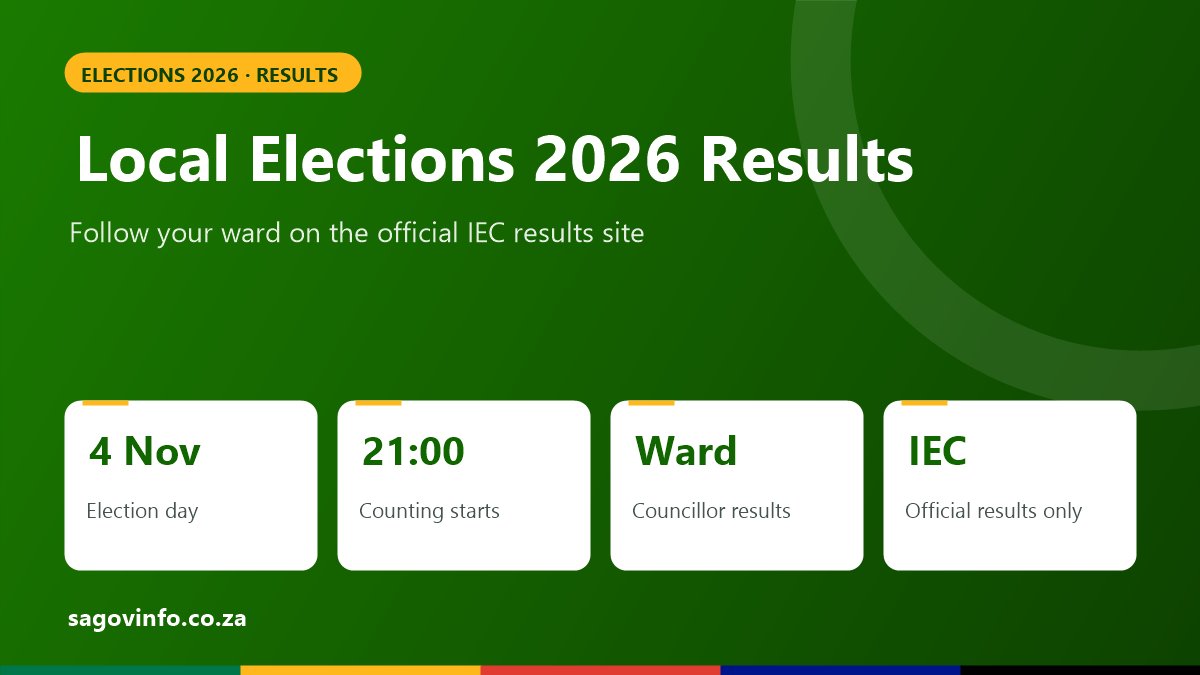
Local Government Elections 2026 Results: When and How to Check Them
Choose SA Gov Info as a preferred source, and Google will show you our SASSA, NSFAS, price and sport updates more often in Top Stories.
Button not showing? Add SA Gov Info as a preferred source on Google
Final Results
IEC chairperson Mosotho Moepya declared the final results at the National Results Operation Centre in Midrand on the night of Sunday 8 November 2026. He said all 213 municipal councils had been finalised and declared, and that the elections were free and fair.
| Party | Share of the vote | Council seats |
|---|---|---|
| ANC | 30.76% | 3,246 |
| DA | 24.64% | 1,695 |
| MK Party | 9.76% | 785 |
| EFF | 6.22% | 588 |
| ActionSA | 5.67% | 313 |
| Other parties and independents | 22.97% | Not given as one total |
The ANC won outright control of 53 municipalities, the DA 12, the IFP 5, the MK Party 3 and Rise Tsantsabane Communities 1, the IEC said. The IEC said 127 councils are hung, so in those councils parties now have to form coalitions to elect mayors (see the hung council section below).
About 14.9 million of the 29.2 million registered voters cast a ballot, a national turnout of 52% (45.9% in 2021), and 1.84% of votes were spoilt. In total, 10,526 council seats were contested by 521 parties and 636 independent candidates.
One voting district must vote again. On 8 November 2026, the IEC ordered a revote at the Jabulani Community Hall voting station in Ward 3 of the Siyancuma Municipality (Douglas, Northern Cape), because ballot papers were destroyed before they could be counted. On 10 November 2026, the IEC set the revote for Wednesday, 18 November 2026, from 07:00 to 21:00. SAnews names the voting district as Bongani Gemeenskapsaal. Special votes there are on Tuesday, 17 November 2026, from 08:00 to 17:00, and voters can apply for a special vote from 10 to 14 November 2026. Only voters on that district’s voters’ roll take part.
Key Dates
| Date | What happens |
|---|---|
| 2 and 3 November 2026 | Special votes (home visits and voting stations) |
| 4 November 2026 | Election day, a public holiday. Voting from 07:00 to 21:00 |
| From the night of 4 November | Counting at voting stations, results start coming in |
| Friday 6 November 2026, 17:00 | Deadline for parties and independent candidates to lodge objections |
| Sunday 8 November 2026 | The IEC declared the final results and council seats in Midrand |
| Within seven days of voting | Results published in the Government Gazette |
| Within 14 days of publication | Councils elect mayors and speakers |
Voting on Election Day
On 4 November 2026, the IEC’s Deputy Chief Electoral Officer, Masego Sheburi, said that 98% of the 23,696 voting stations opened by 07:00, and that all were open by 09:00. A few stations in the Eastern Cape, KwaZulu-Natal and Mpumalanga opened late because of local protests and bad weather. By 10:00, 3,523,691 people had voted, according to the IEC’s early figures. By 17:00 on 4 November 2026, the IEC’s preliminary count was about 12 million voters. About 29.2 million people are registered to vote in these elections.
| Province | Votes cast by 10:00 | Votes cast by 17:00 (preliminary) |
|---|---|---|
| Gauteng | 895,384 | About 3 million |
| KwaZulu-Natal | 623,380 | About 2.5 million |
| Western Cape | 461,264 | About 1.5 million |
| Eastern Cape | 431,123 | About 1.4 million |
| Limpopo | 366,378 | About 1.1 million |
| Mpumalanga | 252,859 | 854,901 |
| North West | 204,736 | 702,133 |
| Free State | 195,537 | 588,237 |
| Northern Cape | 93,030 | 299,381 |
| South Africa | 3,523,691 | About 12 million |
Voting stations close at 21:00. On 4 November 2026, Chief Electoral Officer Sy Mamabolo said that voters who are in the queue at their voting station by 21:00 will not be turned away, even if voting goes on after closing time.
These early numbers are not the final turnout. On 5 November 2026, the IEC’s Masego Sheburi said 15.9 million people took part in the elections, including special votes, and that the final turnout figure was still being worked out. In the final declaration on 8 November 2026, the IEC gave a national turnout of 52%, with about 14.9 million ballots cast. During the count, the IEC’s provincial electoral officer in KwaZulu-Natal, Ntombifuthi Masinga, gave a provincial turnout of 48.7%. Special votes cast on 2 and 3 November are counted together with the election day ballots after voting closes.
How the Count Went
The IEC released the first results late on 4 November 2026, from a voting station at Driefontein Farm in Ward 6 of the Blue Crane Route Municipality in the Eastern Cape. The first ward won in these elections was Ward 3 in the Kamiesberg Municipality in the Northern Cape, which the ANC took with 52.54% of the vote.
By the morning of Thursday 5 November 2026, only about 12% to 14% of voting districts had been counted. At that early stage:
| Province | Leading party in the early count (5 November 2026, morning) |
|---|---|
| Gauteng | DA, ahead of the ANC |
| Western Cape | DA, ahead of the Patriotic Alliance and the ANC |
| KwaZulu-Natal | MK Party, ahead of the ANC and the IFP |
By 17:00 on 5 November 2026, IEC chairperson Mosotho Moepya said more than 60% of the 66,073 results had been captured, and 65 of the 213 municipalities had finished capturing, scanning and auditing. The Northern Cape was furthest ahead (87% captured) and Limpopo furthest behind (23%).
| Province | Results captured by 17:00 on 5 November 2026 |
|---|---|
| Northern Cape | 87% |
| Western Cape | 69% |
| Free State | 64% |
| Eastern Cape | 60% |
| Mpumalanga | 52% |
| KwaZulu-Natal | 37% |
| North West | 35% |
| Gauteng | 35% |
| Limpopo | 23% |
KwaZulu-Natal caught up quickly. By 12:00 on Friday 6 November 2026, the IEC in KZN had captured 12,601 of the 14,245 expected results slips from its 5,028 voting stations (88%), and 82% had been independently audited. eThekwini stood at 64% and Msunduzi at 40%.
By 17:00 on Friday 6 November 2026, the IEC said 91% of the results were complete, and results were finalised in 150 of the 213 municipalities (not counting the 44 district councils). Every municipality in the Northern Cape was done. The IEC said the results stay provisional until all objections and checks are finished.
| Province | Results complete by 17:00 on 6 November 2026 |
|---|---|
| Northern Cape | 100% |
| Free State | 98% |
| Eastern Cape | 95% |
| Mpumalanga | 95% |
| Western Cape | 92% |
| KwaZulu-Natal | 92% |
| North West | 87% |
| Limpopo | 86% |
| Gauteng | 75% |
The IEC received just over 800 complaints by the night of 4 November 2026, mostly from party agents who said they were kept from watching the voting or counting. On 5 November, about 106 were still open. The IEC said it cannot declare final results before 17:00 on Friday 6 November 2026, when the deadline for objections closes, and that results posted at voting stations stay provisional until then, because an objection can lead to a recount.
By 15:00 on Saturday 7 November 2026, the IEC had received 197 objections. It had dismissed 54, 8 were withdrawn and 2 were upheld, and the rest were still being decided. IEC chairperson Mosotho Moepya said the IEC is looking at the objections that could change the result. At that time, results were still being processed in Johannesburg, Ekurhuleni and Emfuleni (Gauteng), Rustenburg (North West), and eThekwini and Msunduzi (KwaZulu-Natal). The other six provinces were done.
The IEC’s results dashboard at results.elections.org.za/dashboards/lge/ shows the final results for every municipality and ward.
How to Check the Results Online
- Go to the official IEC results website, results.elections.org.za.
- Choose the 2026 local government elections.
- Select your province, then your municipality.
- Open your ward to see the ward councillor results.
- Open the municipality’s results to see how many seats each party won.
You can also look at past results there, including the 2021 local elections, and download results files.
What Do the Results Show?
Local elections choose the councils that run your municipality. There are two kinds of results:
| Result | What it means |
|---|---|
| Ward results | The candidate with the most votes in your ward becomes your ward councillor |
| Party (PR) results | Party votes decide how many extra seats each party gets on the council, so that the council matches the parties’ share of the vote |
In a metro, voters get two ballots. In a local municipality outside a metro, voters get three, including one for the district council. See our election day guide for how voting works.
How Results Are Counted
- Counting starts at each voting station as soon as voting closes.
- Party agents can watch the count.
- The result for each voting station is recorded on a results slip, which is signed and sent to the IEC.
- The IEC captures and checks the results before they appear online.
This is why results come in bit by bit through the night and the next days.
What Is a Hung Council?
A council is “hung” when no party wins more than half of the seats. Parties then have to form a coalition to elect a mayor and run the council. In the 2021 local elections, 66 councils were hung, more than twice as many as in 2016.
Watch Out for Fake Results
Fake results and edited screenshots often spread on WhatsApp and social media during elections. Only trust results from the IEC’s official website and official IEC announcements.
2026 Election Results Questions
Who won the 2026 local government elections?
The ANC got the most votes, 30.76% nationally and 3,246 council seats, according to the final results the IEC announced on Sunday 8 November 2026. The DA came second with 24.64% and the MK Party third with 9.76%. The ANC won outright control of 53 municipalities.
When were the 2026 local election results announced?
The IEC announced the final results on the evening of Sunday 8 November 2026 at the National Results Operations Centre in Midrand, after objections had been dealt with. The first results had come in on the night of 4 November 2026.
Where can I check the 2026 election results?
On the official IEC results website, results.elections.org.za.
Can I see the results for my ward?
Yes. Choose your province, municipality and ward on the IEC results website.
What is a hung municipality?
A council where no party has more than half of the seats, so parties must form a coalition.
How many candidates are standing in 2026?
The IEC confirmed 136,790 candidates, the most ever for a local government election.
More: is 4 November a public holiday, green ID book end date and what is trending in South Africa.