
Learnerships 2027 in South Africa: How to Find, Apply and What They Pay
What Is a Learnership?
A learnership combines classroom learning with practical work. It usually lasts about 12 months and ends with a qualification registered on the National Qualifications Framework (NQF). Learnerships are linked to a sector, such as banking, mining, retail, health, IT or government services.
Who Can Apply?
Requirements differ for each learnership. Most ask that you:
- are a South African citizen, often aged 18 to 35,
- have matric (Grade 12) or a specific NQF level,
- are unemployed (for unemployed learnerships), and
- are not already in another funded learnership.
Where to Find Learnerships for 2027
| Where | How |
|---|---|
| SETAs | Each SETA lists learnerships and approved employers in its sector on its website |
| Employers | Banks, mines, retailers and large companies post learnerships on their careers pages |
| Government departments | Departments and municipalities advertise on their websites and the DPSA vacancy circular |
| SA Youth | Register on SA Youth to be matched with opportunities. See SA Youth registration |
| TVET colleges | Many colleges partner with employers for learnerships |
Documents You Usually Need
- Certified copy of your ID.
- Certified copy of your matric certificate or latest results.
- A short CV.
- Proof of address.
- Any other qualifications or certificates.
What Do Learnerships Pay?
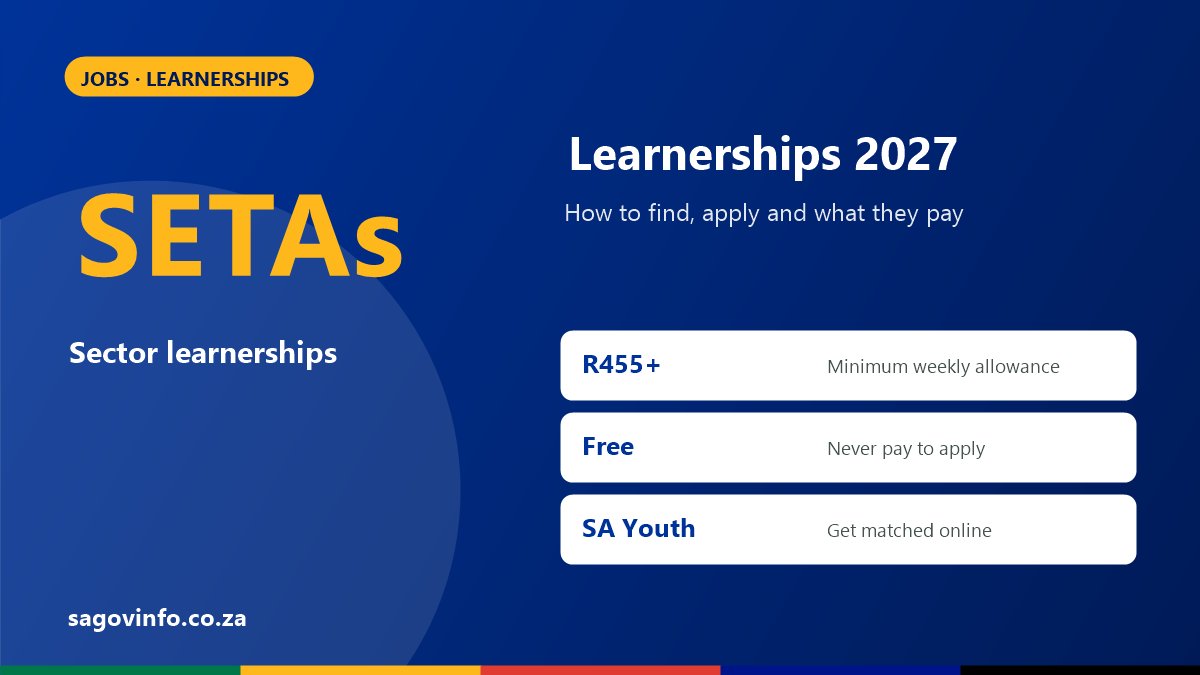
Learners receive an allowance, not a salary. From 1 March 2026, the national minimum weekly allowances for learnerships range from R455 to R2,654.04 a week, depending on the NQF level and the number of credits the learner has completed. Many employers pay more than the minimum. The exact amount is in your learnership agreement.
How to Apply: Step by Step
- Choose a sector that interests you, and check the matching SETA’s website.
- Read the requirements and closing date of each learnership carefully.
- Prepare clear, certified copies of your documents.
- Apply through the official website or email address in the advert.
- Keep a record of every application.
- If you are shortlisted, prepare for an interview or assessment.
Avoid Learnership Scams
- Real learnerships never ask you to pay an application, registration or “processing” fee.
- Be careful with WhatsApp and Facebook adverts that ask for money or your banking PIN.
- Check that the advert appears on the company’s or SETA’s official website.
Learnerships Questions
What is a learnership?
A work-based training programme that leads to a registered qualification, with a monthly allowance.
Do learnerships pay?
Yes. Learners get an allowance. From 1 March 2026 the minimum ranges from R455 to R2,654.04 a week, depending on the NQF level and credits.
Where do I apply for learnerships in 2027?
On employers’ careers pages, SETA websites, government department websites and SA Youth.
Do I need matric for a learnership?
Most learnerships ask for matric or a specific NQF level, but some are open to people without matric.
Do I have to pay to apply for a learnership?
No. Real learnerships are free to apply for.
More jobs and training: EPWP jobs, traffic officer learnerships and TVET college applications.